.png)
A Fragmented Era


1907 marked the beginning of a new era, when the first fully synthetic plastic, known as Bakelite was invented. It was advertised as "the material of 1000 uses."
In just one hundred and twenty years, plastic has become so thoroughly embedded in the architecture of civilization, in packaging, textiles, food contact materials, storage, transport and medical systems and industrial systems as well as thousands of ordinary objects of daily life, that its fragments now circulate through every environmental medium on Earth.
These fragments are what we know as microplastics.
They travel through air, water, food and even the human body.
Plastic was designed for endurance, and endurance is precisely what it delivered.
When plastic breaks apart it doesn’t merely disintegrate and cease to exist, it miniaturizes, and the smaller it becomes the more freely it moves, carried through atmospheric systems, water systems and food systems.
So well-traveled are these tiny particles that researchers have documented them settling in remote locations, far removed from factories and cities, such as the French Pyrenees. [3]
The WHO documents microplastic and nanoplastic particles across air, water, and food, generated through the production, use, and disposal of plastic materials. [2] Further, the FDA notes that both kinds of particles arrive in food largely through the contamination of the environments where food is grown, raised and processed, which is to say they arrive through the world itself, through the shared atmospheric and agricultural and ecological commons. [1]
To know that microplastics are being introduced to our food supply at the fundamental base level is staggering.
While more and more people are beginning to recognize the importance of swapping plastic for glass, silicone or stainless steel in terms of everyday items, the depth of what we are actually dealing with extends far beyond the objects we can swap out and the choices we can make at the store, because the level to which we have embedded ourselves into plastic is not unlike a teenager who sees something on television and decides overnight that they will become that new persona, redecorates their entire room, buys all the clothes, adopts the whole aesthetic, fully committed, no questions asked, and it is only later that the questions arrive and the answers reveal just how little was ever actually understood about what they signed up for.
We did that as a civilization. With a synthetic material we invented less than one hundred and twenty years ago. We covered everything in it before we really knew what it was, and we are only now, slowly, beginning to ask.
Our environment is more than a mere backdrop or landscape. It is that with which we live, interact, and exist. What surrounds us participates in our lives far more than many realize or account for.
We are a civilization that externalized consequence because consequence was not yet visible and convenience was immediate and real. The consequence is now measurable in blood and lung tissue and placenta, in the bodies of people across the globe. [4]
Not only is it present in our bodies, we are now learning the devastating damage it can cause. A 2024 rapid systematic review concluded that microplastic exposure is suspected to harm human reproductive, digestive, and respiratory health, with a suggested link to colon and lung cancer. [5]
Persistence is the weapon plastic wields, because even as it breaks down it remains as microplastics and travels freely, embedding itself into nearly all things it comes into contact with.
Our cage is plastic and our crime was the appeal for convenience.
To go deeper into the research, sources, mechanisms, documented exposure pathways, the full series is waiting for you on Circle.
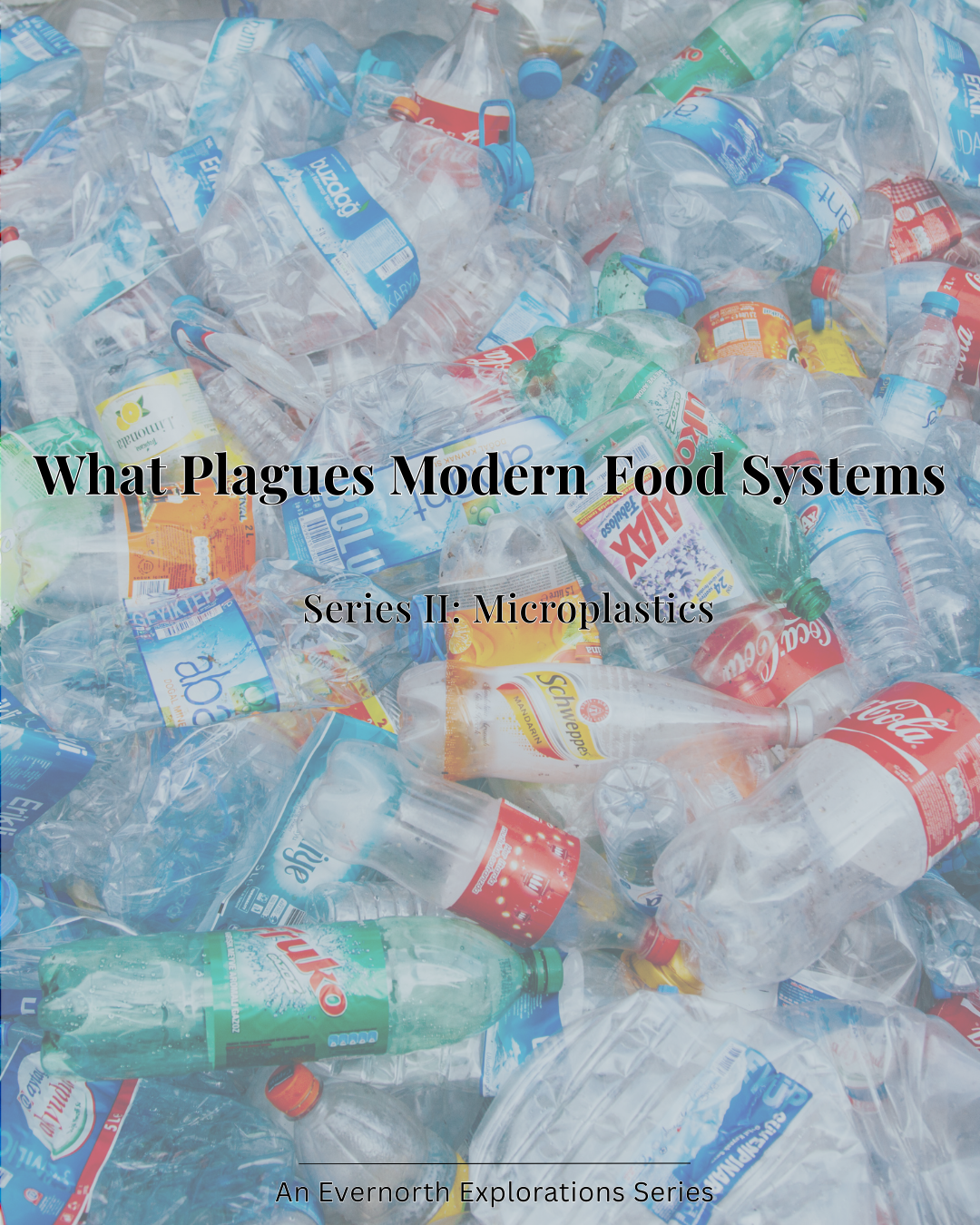
What Plagues Modern Food Systems:
Series II: Microplastics.
Sources:
[1] U.S. Food and Drug Administration. Microplastics and Nanoplastics in Foods.
[2] World Health Organization. Dietary and inhalation exposure to nano- and microplastic particles and potential implications for human health. Geneva: World Health Organization, 2022.
[3] Allen, S., Allen, D., Phoenix, V. R., Le Roux, G., Jiménez, P. D., Simonneau, A., Binet, S., & Galop, D. (2019). Atmospheric transport and deposition of microplastics in a remote mountain catchment. Nature Geoscience, 12, 339–344.
[4] Garcia, M. A. et al. (2024). Quantitation and identification of microplastics accumulation in human placental specimens using pyrolysis gas chromatography mass spectrometry. Toxicological Sciences.
[5] Chartres, N., Cooper, C. B., Bland, G., Pelch, K. E., Gandhi, S. A., BakenRa, A., & Woodruff, T. J. (2024). Effects of Microplastic Exposure on Human Digestive, Reproductive, and Respiratory Health: A Rapid Systematic Review. Environmental Science & Technology.


Comments