.png)
You Didn't Think Twice

Updated: Mar 7

Whether you're a licensed contractor or a first time DIYer, you’ve run into a situation where something doesn't fit. Minor issue. You simply decide to trim it down. You don’t pause before trimming a board that carries certifications. You don’t read the patent before making a necessary cut.
Who does that?
You reach for the blade and make the necessary cut because the job requires it, and the material is safe… it says so, and you have no reason not to believe it.
So, you cut it. Just like that. Like so many people do.
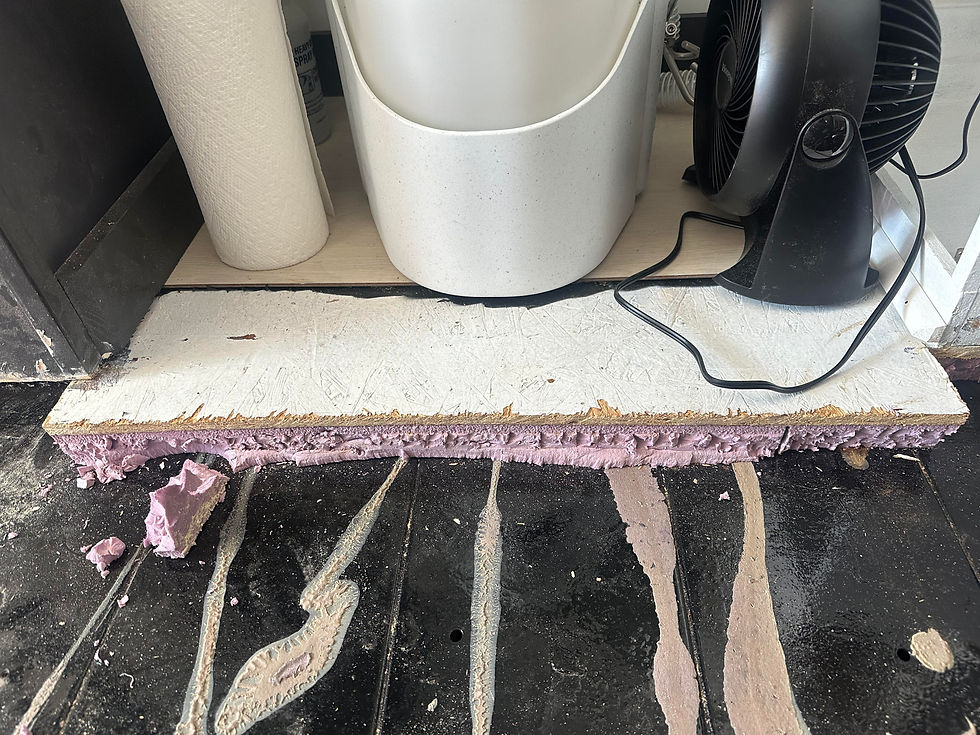
The product is Owens Corning FOAMULAR NGX (Next Generation Extruded), a purple-colored XPS rigid foam board that is a hyper-elastic polymer grid widely used in cushioning systems. It is marketed as safe and sustainable. It ships by the millions into homes, job sites, and renovation projects across the world. Trimming it to fit a space is not unusual; it’s expected, typical, standard. This is one of the better-regarded materials, one of the ones with credentials.
However, what no certification discloses is what happens the moment the structure is opened.
The grid is a synthetic elastomer gel. Patent documentation describes it as a mineral-oil-extended A-B-A triblock copolymer, a thermoplastic elastomer system that behaves like rubber while retaining the processability of plastic.(WO2024159240A1). Inside the polymer matrix: polymer chains, mineral-oil plasticizers, stabilizers, processing additives. Contained, as long as the material remains sealed.
Intact is the operative word.
Low-molecular-weight compounds migrate through polymer materials over time, residual monomers, additives, plasticizing fractions. When the internal structure is opened, several things happen at once: internal polymer surfaces meet open air, plasticizing oils migrate toward newly exposed edges, and microscopic polymer fragments are created during the cut itself (Hossain et al., 2023).
Each of these mechanisms can release volatile organic compounds into the surrounding air. Research into thermoplastic elastomer emissions confirms that processing and mechanical disturbance of these materials generate measurable VOC release (Kaczmarski et al., 2022).
This is documented.
Federal guidance acknowledges that disturbing foam and polymer materials can release airborne particles containing chemical components from production (EPA). Occupational safety research documents airborne contaminants generated when plastics are machined or cut (NIOSH).
These outcomes aren't from an error, they are from the ordinary act of making it fit.
Indoor air can be thought of as an entirely different stratosphere than its outdoor counterpart.
Ventilation is slower. Air exchange is limited. A compound released inside a room doesn’t disperse, instead it lingers in the enclosed space.
Industrial environments design their ventilation with this reality built in.
Residential spaces do not. That gap is not accidental. It is the place where the burden transfers from manufacturer to inhabitant.
One precaution bridges it: step outside to cut. Let the open air take what the blade releases. It costs nothing. It changes everything about what comes back inside with you.
Nobody writes a warning label for this.
Nobody tells the contractor, the builder, the person fitting out a room or a project space that the certified material in their hands has an interior that's harmful when exposed.
The knowledge exists in polymer science and in patent filings most people will never read. It simply doesn’t travel to the hands holding the blade.
My goal is to inform people of the materials they’re working with, to announce the fine print, and to make sure the knowledge that exists actually reaches the people who need it, before the cut, not after.
This is what it means to know what you’re working with.
Sources
WO2024159240A1 — Hyper-elastic polymer elastomer composition. https://patents.google.com/patent/WO2024159240A1
Hossain et al. (2023) — Thermoplastic elastomer structure and additive migration. PMC. https://pmc.ncbi.nlm.nih.gov/articles/PMC10300744/
Kaczmarski et al. (2022) — Thermoplastic elastomer additives and VOC emissions. Polymers, 14(9), 1795. https://www.mdpi.com/2073-4360/14/9/1795
U.S. Environmental Protection Agency — Safer workplace practices for spray polyurethane foam installation. https://www.epa.gov/saferchoice/safer-workplace-practices-spray-polyurethane-foam-installation
National Institute for Occupational Safety and Health (NIOSH) — Plastics processing hazards. https://www.cdc.gov/niosh/topics/plastics/


Comments